


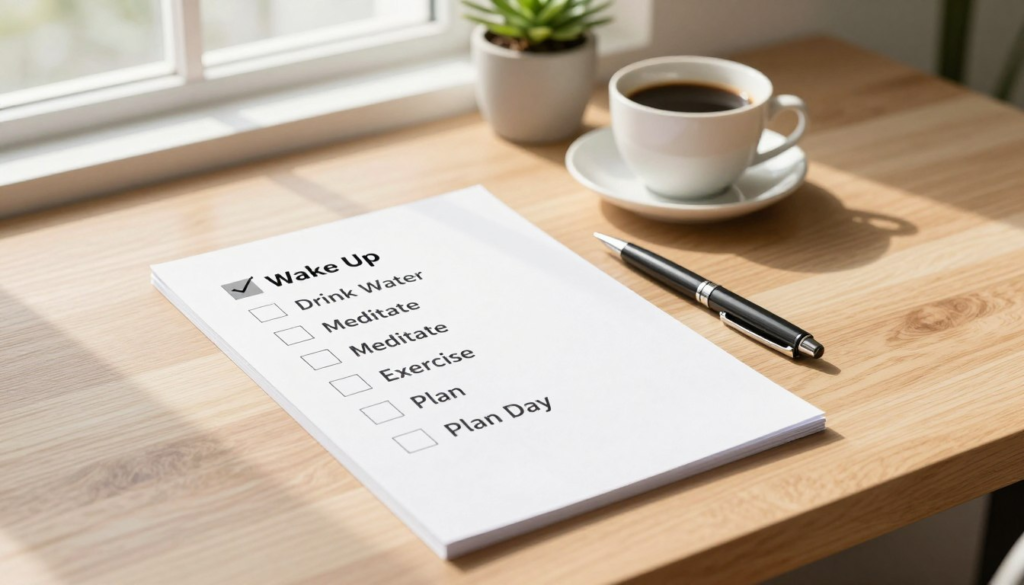
Ever notice how the first 15 minutes of your morning can decide the mood of your whole day? When you start in a rush, your brain stays in “catch up” mode. When you start with a simple plan, you feel steady—even if the rest of the day gets loud.
This morning routine checklist for adults is built for real life: limited time, limited energy, and a schedule that doesn’t always cooperate. No 5 a.m. miracle routines. No pressure to “optimize” everything. Just a short, repeatable start that helps you wake up, reset your body, and choose your top priorities before the world starts asking for them.
One important note before we begin: the best morning routine is the one you’ll actually do. That means it has to be small, obvious, and easy to repeat.
Why a 15-Minute Morning Routine Changes Everything
A short routine works because it doesn’t rely on motivation. It relies on structure. You’re basically giving your brain a “default path” to follow while you’re still waking up.
When your morning has a predictable sequence (wake → water → light → movement → plan), you reduce decision fatigue and start the day with a small win. Over time, that consistency matters. Sleep experts regularly highlight that keeping a stable sleep/wake rhythm supports better energy, focus, and overall health—and adults generally benefit from getting 7+ hours of sleep regularly.
And there’s a “biology bonus” here too: light exposure and timing help regulate the body’s internal clock (your circadian rhythm). That’s why a little morning light can feel like someone turned your brain on.
Setting Yourself Up the Night Before


If your mornings feel chaotic, don’t fix the morning first—fix the night before. A two-minute setup can “buy back” your morning brainpower.
A 5-minute night-before checklist
- Put a glass or bottle of water where you’ll see it first (bedside or kitchen counter).
- Choose tomorrow’s outfit (even if it’s just “work top + jeans”). Hang it where you can grab it.
- Pack essentials (work bag, gym bag, kid bags, keys, wallet).
- Decide your “first task” for tomorrow (one sentence). Example: “Send invoice before 10.”
- Set your wake time and keep it realistic. Consistency beats ambition.
If you want your 15-minute morning to feel calm, your goal tonight is simple: remove one decision from tomorrow morning.
The First 5 Minutes: Wake Up and Hydrate
These first minutes are about switching from “sleep mode” to “start mode” without scrolling, negotiating, or overthinking.
Skip the snooze button (the simple version)
Snoozing can feel harmless, but repeated alarms may fragment the final part of your sleep and leave you groggy (that heavy “sleep inertia” feeling). If you’re a habitual snoozer, try this instead: set one alarm, place it across the room, and make your first action “feet on floor.”
Start with water (before coffee)
You don’t need a trendy supplement routine. Just drink water. After hours of sleep, a glass of water is an easy way to feel more awake and support normal hydration. (Coffee can come right after—water just goes first.) Most adults need regular, quality sleep and hydration habits to function well day to day.
Get light exposure for natural energy
Open the curtains. Step outside for 60 seconds. Stand by a bright window. Light helps anchor your circadian rhythm and signals “daytime” to your body. This is one of the most underrated morning habits because it’s free and takes almost no effort.
Minutes 6-10: Movement and Mindfulness

This is where you turn your body “on” and quiet the mental noise—without needing a workout plan or meditation app.
A 3-minute stretch sequence (no equipment)
- Neck release (30 seconds): gentle side-to-side, slow breaths.
- Shoulder rolls (30 seconds): forward 10, backward 10.
- Forward fold (45 seconds): bend knees, relax your back.
- Hip opener (45 seconds): step one foot forward, shift gently.
- Calf/ankle wakes (30 seconds): slow heel raises.
Short bursts of movement can still support health and mood, and the CDC notes that physical activity has wide-ranging benefits—even when it’s not a long gym session.
A 2-minute breathing reset (easy to remember)
Try this: inhale through your nose for 4, exhale through your mouth for 6. Repeat for 10 rounds. That’s it. The longer exhale helps your body downshift from “rush” to “ready.”
Minutes 11-15: Personal Care and Planning

This final block is what makes the routine “work” in real life. It’s not just wellness—it’s direction.
Streamlined hygiene (keep it automatic)
Keep this boring on purpose: bathroom, brush teeth, wash face, deodorant, get dressed. If you want to level up your mornings, set up your bathroom like a “one pass” station—everything you need is visible and within reach.
Pick your Top 3 (one sentence each)
Write three priorities on paper (not your phone). One work priority, one personal priority, and one “maintenance” priority.
- Work: “Finish the draft by 2 p.m.”
- Personal: “Walk for 20 minutes after lunch.”
- Maintenance: “Pay the bill / book the appointment / take out recycling.”
This is how you stop mornings from becoming reactive. You’re choosing the day before the day chooses you.
Your Complete Morning Routine Checklist for Adults

Copy/paste this section into a note, print it, or stick it on your fridge—whatever makes it visible.
The printable 15-minute template
- 0–1 min: Feet on floor, curtains open
- 1–3 min: Drink a glass of water
- 3–5 min: Light exposure (window/outside)
- 5–8 min: 3-minute stretch sequence
- 8–10 min: 2-minute breathing reset
- 10–13 min: Hygiene + get dressed
- 13–15 min: Write Top 3 priorities
| Step | What you do | Why it helps |
|---|---|---|
| Water + light | Hydrate, open curtains | Signals “daytime” and supports alertness |
| Move + breathe | Stretch and slow exhale breathing | Wakes the body, reduces mental noise |
| Plan | Write Top 3 | Creates direction and reduces reactivity |
If you want to build consistency, track it with something physical (a simple checkbox calendar). If you like printables, pair this with a habit tracker so you can see your streak.
If You Only Have 5 Minutes
Some mornings are survival mornings. Don’t quit the routine—shrink it.
- Minute 1: Water
- Minute 2: Open curtains / step outside
- Minute 3: Shoulder rolls + forward fold
- Minute 4: 4-in / 6-out breathing x 5
- Minute 5: Write ONE priority (“If I only do one thing today, it’s…”)
This keeps the habit alive—and that’s the real win.
Customizing Your Productive Morning Routine
Your routine should match your life, not fight it. Here are three simple ways to tailor the same 15 minutes.
If you wake up anxious
- Keep light exposure gentle (window, not harsh overhead lighting).
- Spend extra time on the slow-exhale breathing (3 minutes instead of 2).
- Write Top 3, then add: “What can wait until tomorrow?”
If you wake up sluggish
- Go outside for light if possible (even briefly).
- Swap stretching for a brisk 2-minute walk around your home.
- Choose a “first task” that’s easy to start (not the hardest task of the day).
If you wake up rushed (kids, caregiving, shift work)
- Do water + light while the kettle boils.
- Use micro-movement: calf raises, shoulder rolls, neck release.
- Write Top 3 after you drop kids off or after your shift ends—keep the routine, move the timing.
If your mornings are consistently chaotic, consider pairing this with a simple evening reset. Even a 10–20 minute daily reset routine for a clean home makes mornings smoother because you’re not starting the day surrounded by unfinished business.
Common Morning Routine Mistakes to Avoid
1) Overcomplicating the routine
If your routine has 12 steps, you’ll only do it on perfect mornings. Keep it to a few “anchors” (water, light, movement, plan). You can always add later.
2) Starting with your phone
Notifications push you into reaction mode. Try a simple rule: no phone until your Top 3 is written. If you need your phone for an alarm, leave it across the room and avoid “just checking” anything else.
3) Treating missed days like failure
Consistency is the goal, not perfection. If you miss a morning, restart with the 5-minute version the next day. That prevents the “I already messed up” spiral.
The Long-Term Benefits of Starting Your Day Right
When you start your day with a predictable routine, you’re doing more than checking boxes. You’re building a stable base that supports better focus, calmer decisions, and more consistent energy.
Two habits do the heavy lifting over time: consistent sleep/wake timing and morning light exposure. Both support your internal body clock, which influences alertness and daily rhythm.
And the most practical benefit? You stop starting the day in panic mode. That alone changes how you show up at work, at home, and in your own head.
Conclusion
A strong morning routine doesn’t need to be long. It needs to be repeatable.
If you take nothing else from this article, take this: start with water, add light, do a little movement, and choose your Top 3. That’s a 15-minute start that works—even when life doesn’t.
FAQ
Why is a morning routine checklist helpful for adults?
Because mornings are when decision fatigue hits hardest. A checklist removes the need to “figure it out” while you’re half-awake and keeps you consistent.
Do I really need to wake up earlier for this?
No. Start by using 15 minutes you already have: reduce scrolling, prep the night before, or shorten one low-value task. If you can’t get 15, use the 5-minute version and build from there.
What if I’m not a “morning person”?
That’s exactly why a short routine works. You’re not trying to become someone else—you’re just giving your day a stable starting line. Light exposure and gentle movement can help you feel more alert as your body adjusts.
How can I stop hitting snooze?
Put your alarm across the room and make “feet on floor” the only goal. If snoozing is a habit, try shifting your bedtime earlier by 15 minutes and keeping your wake time consistent. Repeated alarms can contribute to grogginess for some people.
How do I stay consistent on weekends?
Keep the same “anchors” (water, light, movement), but relax the planning step if you want. Many sleep experts emphasize that regular sleep timing supports better overall sleep and daytime function.
About Author
ali Wheater: Habertor Editorial Team
We publish practical routines that make daily life feel lighter—cleaner homes, calmer schedules, and habits that are actually doable.
Last updated: March 2, 2026.