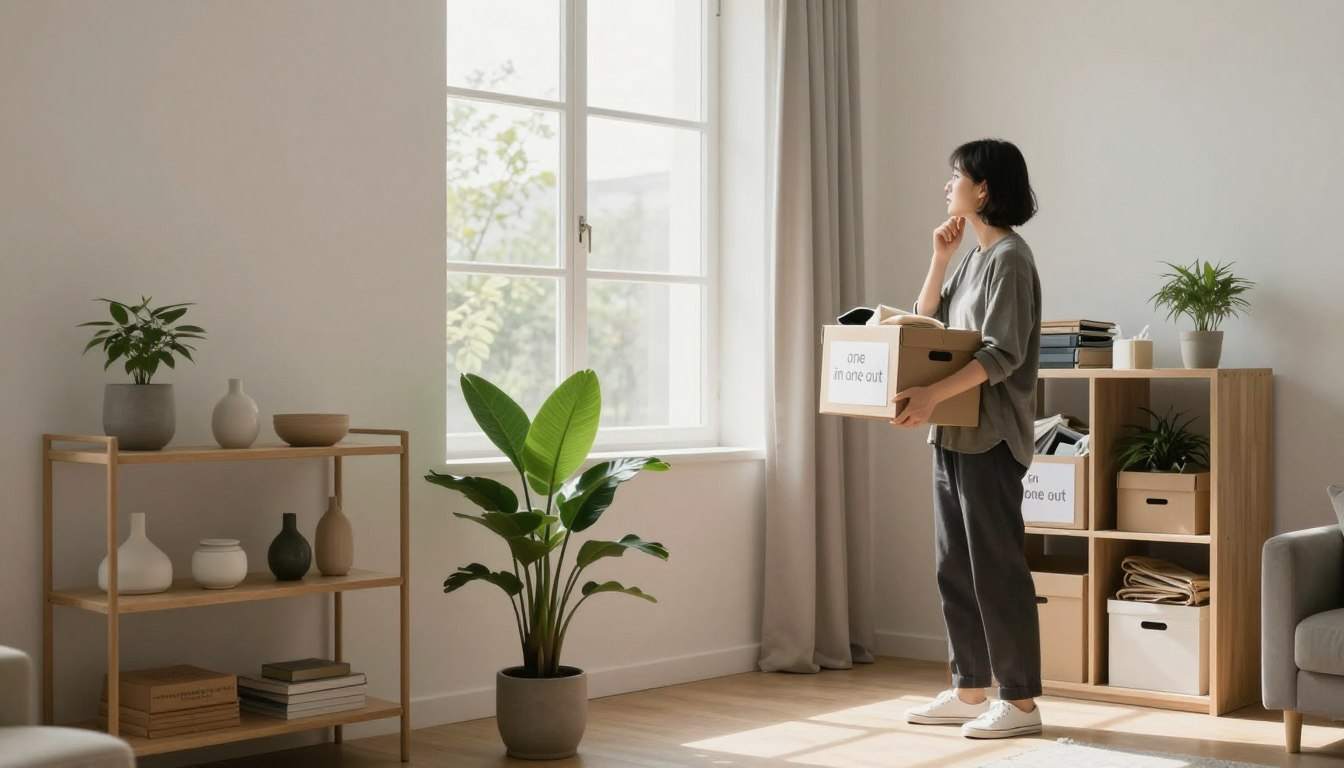
Clutter rarely arrives in one dramatic weekend. It sneaks in through shopping bags, “just-in-case” purchases, hand-me-downs, online orders, and those little freebies you don’t even remember accepting. Then one day you open a drawer and realize it barely closes.
The one in, one out rule is the simplest way to stop that slow creep. It’s not a dramatic purge. It’s a practical home habit: when something new comes in, something else leaves. That’s it. No guilt. No perfection. Just a steady system that keeps your home from backsliding into chaos.
This guide shows you how to use the one in, one out rule in real life—when you’re busy, when you have kids, when gifts happen, and when you truly need new things. You’ll get clear examples, room-by-room ideas, and a printable-style checklist you can keep on your phone or stick inside a cabinet door.
Key Takeaways
- Stop clutter at the source by pairing every “in” with an “out.”
- Make shopping easier because you’ll know what space you’re protecting.
- Keep your home livable without extreme minimalism or all-day decluttering sessions.
- Build a simple removal system so “out” items don’t sit in a corner for months.
Understanding the One In, One Out Rule (and Why It Works)
One in, one out is a boundary you set for your space. The point isn’t to “own nothing.” The point is to keep your home in balance so you can find what you have, clean faster, and actually enjoy your rooms.
It works because it shifts decluttering from a once-a-year event into a tiny decision you make in the moment. Instead of waiting until things overflow, you handle the problem while it’s still small.
What Counts as “One”?
This is where people get stuck—so let’s make it simple. “One” can mean:
- One item for one item (buy a new sweater → donate an old sweater).
- One category for one category (new mug → old mug; new book → old book).
- One space for one space (new board game → remove enough games so the shelf stays easy to use).
If item-for-item feels too strict (or too easy to “cheat”), space-based is often the most realistic. Your goal is not math. Your goal is your storage staying functional.
Why the One In, One Out Rule Changes Everything

Most decluttering fails for one reason: stuff keeps entering. The one in, one out rule fixes that. It keeps your home from “refilling” after you clean it.
It prevents clutter from accumulating
Clutter isn’t just too many things—it’s too many things without a home. When you pair every new item with an exit, you protect the space you already fought to clear.
It makes you a more thoughtful shopper
If you know a new item means removing something, you pause. You start asking better questions:
- Do I already own something that does this job?
- Is this replacing something, or just adding?
- Where will it live—without stuffing a drawer?
It keeps balance without “extreme minimalism”
You can still love decor, hobbies, books, and cozy extras. The rule simply asks you to keep a comfortable limit—so your home supports your life instead of storing your past.
Start Here: Set Up Your “Out” System (So the Rule Actually Works)

The biggest reason people quit the one in, one out rule is that the “out” part becomes inconvenient. Fix that once, and the rule becomes almost automatic.
Create a simple exit station
Pick one spot in your home (a closet corner, laundry room shelf, entryway basket) and set up:
- Donate bin (clean, usable items)
- Sell bin (higher-value items you’ll actually list)
- Recycle bin (paper, cardboard, approved plastics)
- Trash (broken, stained, unsafe items)
Rule of thumb: if you won’t list it this week, it goes to donation (or recycling/trash). A “sell pile” that never moves is just clutter in disguise.
Choose your matching style
Decide how strict you want to be. Here are realistic options:
- Classic: one in, one out (best for most categories).
- High-clutter zones: one in, two out (kids’ toys, makeup, mugs, “random drawer”).
- Space rule: the drawer/shelf must close easily and nothing can block access.
Pick one approach and stick to it for 30 days. You can tighten the rule later—once it’s a habit.
Room-by-Room: Practical Ways to Use One In, One Out
You don’t have to apply the rule to everything overnight. Start with the areas where clutter annoys you most (usually closets, kitchen counters, and kids’ stuff). Below are the most common categories and how to handle them without overthinking.
Wardrobe and Closet: The Easiest Win

Clothes are perfect for this rule because they’re easy to match. If a new item enters, you immediately choose what leaves.
Clothing and accessories strategy
Use category matching so your closet stays usable:
- New jeans → old jeans
- New gym top → old gym top
- New handbag → old handbag
If you struggle to choose, compare honestly: fit, comfort, condition, and how often you reach for it. If you haven’t worn it in a year and it doesn’t serve a real purpose (formalwear, work uniform), it’s a strong candidate to go.
Seasonal rotation without chaos
When you swap seasons, do a quick “out” sweep:
- Pull out seasonal items.
- Remove anything damaged, uncomfortable, or never chosen.
- Store the rest neatly (one bin per category works better than one giant bin).
This keeps “seasonal storage” from becoming a clutter warehouse.
Kitchen and Pantry: Keep Counters Clear and Cabinets Useful

Kitchens get cluttered because we mix three things in one space: tools, food, and daily life. The one in, one out rule works best here when you apply it by category and by space.
Gadgets and small appliances
If a new gadget arrives, ask: what is it replacing? If the answer is “nothing,” it’s likely clutter. Great swaps include:
- New blender → old blender (or the bulky one you never pull out)
- New pan → scratched pan
- New baking tool → duplicate you already own
Keep a “prime real estate” rule: counters and the easiest shelves are for daily-use items only. If something isn’t used weekly, it should earn its space elsewhere—or leave.
Dishes, mugs, and food containers
These categories multiply fast. Choose a hard limit that matches your household size, then protect it:
- New mug → donate one mug (or more if you have a “mug mountain”)
- New storage set → recycle mismatched lids/containers that don’t pair
- New plates → remove chipped or unused plates
For food storage, pairing matters more than quantity. A smaller set that stacks well beats a giant drawer of lonely lids.
Pantry items (the “consumables” exception)
Food is different because it gets used up. Instead of one in, one out, use a simple boundary: one open backup per staple. Example: one open ketchup + one unopened backup is fine; five backups is pantry clutter.
When you bring in groceries, do a 30-second rotation: move older items forward and place new items behind. This prevents the “mystery expired jar in the back” problem.
Bathroom: Control the “Small Stuff” That Takes Over Drawers
Bathrooms fill up with tiny items: skincare samples, half-used products, travel minis, backups, hair tools. This is a perfect place for one in, two out if your drawers are already crowded.
Try these simple rules:
- New shampoo → finish or donate (unused/unopened) an extra bottle, or recycle empties immediately
- New makeup item → toss expired makeup or pass along what you never reach for
- New towel → remove a worn towel (rags count as “out” only if you truly use them)
Important: for hygiene and safety, don’t donate opened personal care products. If it’s used, it’s usually trash or recycle (where accepted).
Kids’ Toys and Clothes: Make It Simple Enough to Maintain
With kids, clutter grows through growth spurts and well-meaning gifts. The secret is to make the “out” step easy and visible—so it doesn’t become a debate every time.
The toy swap basket
Put a small basket in the play area labeled “Donate.” When a new toy comes in, your child picks one toy to place in the basket. Once the basket is full, it leaves the house (donation, hand-me-down, or recycle).
Clothes: size-in, size-out
When you buy the next size up, remove what no longer fits. Keep a single “sentimental” box if you truly want to save a few items—limit the box, not your emotions.
Books, Paper, and Digital Stuff: Decluttering Isn’t Only Physical
Paper stacks and digital clutter create the same frustration: you can’t find what you need when you need it.
Books and magazines
For every new book, choose one to donate (unless you’re building a deliberate collection). If you save magazines “to read later,” set a time limit. If you don’t read it within a month, recycle it.
Subscriptions are the digital version of clutter
A practical twist: new subscription in → old subscription out. Streaming services, memberships, apps—these can quietly drain money and attention. Keeping them balanced is the digital declutter version of this rule.
Files and photos
If your downloads folder is a mess, use one in, one out as a weekly habit: every time you save something new, delete one old file you no longer need. Small actions prevent a huge cleanup later.
Gifts, Hand-Me-Downs, and Sentimental Items: The Tricky Part

This is where most people give up. Not because the rule is hard—but because emotions are real. Here’s the gentle, practical way through it.
Gifts: gratitude doesn’t require storage
You can appreciate the thought behind a gift without keeping the item forever. If something doesn’t fit your life, thank the giver—and then give the item a home where it will be used. Keeping something out of guilt usually turns it into clutter that silently stresses you out.
Hand-me-downs: accept with a boundary
Hand-me-downs can be helpful, but only if you have space and a plan. Before accepting bags or boxes, choose:
- One drawer, one shelf, or one bin where these items can live.
- A quick sorting moment (keep / donate / recycle) before anything enters your main space.
Sentimental items: container limits beat emotional battles
If everything is sentimental, nothing gets chosen—and the clutter stays. Instead of trying to judge every memory, set a container limit:
- One memory box per person
- One shelf for display
- One album for special papers and letters
When the container is full, the rule applies: if something new goes in, something else must leave. This keeps memories meaningful instead of buried.
Printable-Style Cheat Sheet: One In, One Out Checklist
Use this as your quick reference. Screenshot it, print it, or keep it in a notes app.
- Choose your rule: one in/one out, one in/two out, or space-based.
- Create an exit station: donate + sell + recycle + trash.
- Decide your matching style: same category (best) or same space (good).
- Make “out” immediate: item goes to the exit station the same day.
- Set a weekly drop-off: donations leave the house every week (or every two weeks).
- Keep one “pending” bin only: if it overflows, you must donate instead of selling.
- Review your hotspots monthly: one shelf, one drawer, one cabinet—done.
Common Mistakes That Make the Rule Fail (and Easy Fixes)
Mistake 1: Saving “out” items in a pile
Fix: Put them in a bin immediately. A pile is mentally loud. A bin is contained and scheduled.
Mistake 2: Using “out” as an excuse to buy more
Fix: Add a pause rule: wait 24 hours before non-essential purchases. If you still want it tomorrow and you know what’s leaving, you’re buying intentionally—not emotionally.
Mistake 3: Trying to apply it to everything at once
Fix: Start with one category for two weeks (clothes, mugs, toys). When it becomes automatic, expand.
Mistake 4: Not agreeing on household rules
Fix: Keep it simple: each person manages their own “one in, one out” categories first (clothes, personal items). Shared spaces can come later once everyone sees the benefit.
How to Make One In, One Out a Lasting Habit
If you want this to stick, aim for automatic, not perfect.
Use a “landing zone” rule for new items
New items don’t get scattered around the house. They go to one spot (a chair, bench, or entry table) until the matching “out” item is chosen. No “out,” no unpacking. This turns the rule into a real boundary.
Do a 5-minute weekly reset
Once a week, set a timer for five minutes:
- Empty your donation bin into the car (or schedule pickup).
- Recycle papers and packaging.
- Throw away broken items you’ve been “meaning to fix.”
This keeps the exit station from becoming a second clutter zone.
FAQ
What is the one in, one out rule for decluttering?
It’s a simple habit: when you bring a new item into your home, you remove a similar item (or enough items to keep the same storage space functional). It prevents clutter from building up again.
Do I have to remove the exact same kind of item?
Matching by category is easiest (new shirt → old shirt), but you can also match by space (new board game → clear space on the game shelf). The goal is maintaining balance, not perfect counting.
What if I’m replacing something that’s broken?
That’s the cleanest version of the rule. The broken item is your “out.” Don’t store broken items “until later” unless you have a real repair plan and a deadline.
How do I handle gifts without offending people?
Accept the gift with gratitude. Then decide whether the item fits your life and your storage limits. Keeping something out of guilt often turns into hidden clutter. If you won’t use it, let it go to someone who will.
Can this work for families with kids?
Yes—especially if it’s simple. Use a “donate basket” for toys and a size-based rule for clothes. Kids can participate by choosing what leaves when something new arrives, which builds a healthy habit early.
What if I truly need to bring in more items than I remove?
Life changes happen—new baby, new job, moving, starting a hobby. In those seasons, use a modified rule: keep storage functional and do a weekly “out” sweep. Once the transition settles, return to one in, one out to protect your space long-term.
Conclusion: A Calm Home Is Built One Decision at a Time
The one in, one out rule isn’t about deprivation—it’s about control. It gives you a clear, repeatable way to keep your home from filling up faster than you can manage it.
Start small. Choose one category. Set up your exit station. Then let the rule do what it does best: protect your space, protect your time, and make “tidy” feel normal—not exhausting.